
Wine bottle gift boxes are a glass-containment problem wearing a gift-wrap. When a buyer searches “wine bottle gift boxes,” they are asking how to ship a 750 ml glass vessel of liquid through three courier handlers without a leak, a clink, or a crack — and still have it read like a present on arrival. A single broken bottle is a stain, a refund, and a review; the box is the only thing standing between the product and the floor. This guide covers leak-proof thermo-sealed liners, bottle lock inserts, cavity design, and the MOQ math for safe wine gifting. We keep it spec-level so the line you send a factory contains the glass instead of hoping the foam does.
Every spec below comes out of our own plant in Dongguan — see Allen Paper Products for the full capability list.
Why Wine Is a Containment Problem
A wine bottle is heavy, round, and full of liquid — the worst combination for transit. It rolls, it clinks against neighbours, and if the seal fails it leaks through the board. A plain carton with a slip of paper does none of the three jobs: it does not lock the bottle, it does not absorb a drop, and it does not cushion the glass. The package needs a liner that seals, an insert that locks, and a wall that cushions.
The trade-off is weight vs protection. A thick rigid box protects but costs freight; a lined mailer protects lighter. Most wine gifting uses a rigid or telescope carton with a thermo-sealed liner and a moulded insert, because the bottle is the gift and the box is its insurance.
For the related spec, see custom printed paper bags — same board grades, same tolerances.
Leak-Proof Thermo-Sealed Liners
The liner is the last line against a leak:
- Thermo-sealed liner: a film heat-welded to the board, zero seam for liquid to find.
- PE-coated insert: a tray that catches a drop but has a seam.
- Foil pouch inside: full leak barrier, adds a step.
- EVA pad base: absorbs minor seepage, cushions drop.
A wine bottle gift boxes order that specifies a thermo-sealed liner protects the carton from the first drop; one that says “waterproof” without naming the weld leaves a seam the wine finds. Require the seal method, because a glued liner has a seam and a thermo-sealed liner does not.
For the related spec, see custom paper boxes — same board grades, same tolerances.
For the underlying standard, see FSC chain-of-custody certification.
Bottle Lock Inserts Compared
| Insert | Lock | Cushion | Cost | Best for |
|---|---|---|---|---|
| Moulded pulp | High | High | Mid | Single bottle |
| EVA cradle | High | High | Higher | Premium |
| Corrugated divider | Medium | Medium | Low | Multi-bottle |
| Foam wrap | Low | Medium | Low | Budget |
A moulded pulp or EVA cradle holds the bottle by the neck and base so it cannot roll or clink. A corrugated divider works for a multi-bottle set but cushions less. Pick the insert by the bottle count and the drop risk, because the lock is what stops the clink.
For the related spec, see packaging by industry — same board grades, same tolerances.
Cavity Design and the Drop
The cavity depth and the locating tab decide whether the bottle stays put:
- Neck slot: locks the top so the bottle cannot pivot.
- Base cradle: seats the bottom so it cannot slide.
- Locating tab: stops rotation in transit.
- Slack fill: kraft around the cavity absorbs shock.
A wine bottle gift boxes cavity that is 2 mm larger than the bottle lets it pivot and clink; one that matches the diameter locks it. Name the bottle diameter in the PO so the cavity is cut to the vessel, not the average. The clink is a cavity problem, not a board problem.
For the related spec, see our packaging factory — same board grades, same tolerances.
For the underlying standard, see ASTM International test standards.

Mini Story: The Bottle That Broke in a Plain Carton
A vineyard shipped bottles in a rigid carton with a paper slip and no insert. One bottle pivoted, clinked the neighbour, and cracked; the leak soaked six cartons in the same case and the whole shipment was refunded. The brand re-spec’d a thermo-sealed liner, a moulded pulp cradle with a neck slot, and a 2 mm tighter cavity, kept the same rigid carton, and the breaks stopped. The fix was liner plus cradle, not a new box. The first PO had left the insert blank; the second named it, and the difference was a soaked case versus a clean one.
For the underlying standard, see the EPA recycling guidance.
Mini Story: The Liner That Saved the Season
A gift retailer shipped wine in cartons with a glued PE tray. A heat-wave expanded the glue seam and a slow seep reached the board on 4% of orders. They switched to a thermo-sealed liner with no seam; the seep had nowhere to go and the cartons stayed dry. A wine bottle gift boxes decision that names the seal method protects the carton in a way a “waterproof” adjective never can — the weld, not the word, holds the line.
Printing and the Premium Feel
Wine gifting is presentation, so the print carries the ritual:
- CMYK outside: full colour label feel, mid cost.
- Foil accent: premium, mid–high cost.
- Soft-touch laminate: velvet surface, premium.
- Emboss: subtle logo, higher cost.
- Inside print: unboxing message, higher cost.
A wine bottle gift boxes carton that pairs CMYK outside with a foil accent reads considered for a fraction of full foil. Name the print sides so the cost lands where the eye does, and the box presents like a flagship instead of a shipper.
MOQ, Lead Time, and the Gifting Clock
Wine gifting peaks at holidays, so the clock is tight:
- Digital short-run: 500–1,000 units, 1–2 weeks.
- Offset: 3,000+ units, 3–5 weeks.
- Moulded insert: higher MOQ, longer tooling.
- Thermo-sealed liner: higher MOQ than glued.
Pricing drops above 3,000 units as the dieline spreads. The gifting clock matters — a Q4 run ordered in October misses the shelf. Plan the insert tooling in summer so the bulk ships before the peak. A supplier that names the ex-factory date protects the season.
RFQ Lines for Wine Boxes
The RFQ that returns a real number names the glass and the seal:
- Bottle diameter, height, weight.
- Liner seal method (thermo-sealed vs glued).
- Insert type and cavity count.
- Board grade and cushion spec.
- Print sides and finish.
- MOQ and holiday-window date.
A wine bottle gift boxes supplier that answers all six with numbers is quoting a container; one that says “we do wine boxes” is quoting a carton. The holiday window matters most — stating it lets the factory hit the date before the peak.
7 Spec Lines for a Wine Pack
- Bottle diameter and height stated.
- Liner seal method named (thermo-sealed).
- Insert type and cavity count listed.
- Board grade and cushion spec noted.
- Neck slot and locating tab specified.
- Print sides and finish listed.
- MOQ and holiday-window date in contract.
A wine bottle gift boxes order that fills all seven builds a carton that contains the glass; one that leaves the liner blank builds a leak.
Dividers for Multi-Bottle Wine Sets
When the order is two, three, or six bottles, the divider is the structure that stops a row of glass from becoming a row of clinks. A single-bottle cradle is a solved problem; a multi-bottle set is a divider problem. The divider carries the load that a one-bottle cavity never faces, because every extra bottle is another neighbour it can pivot into.
The divider has three jobs: keep bottles apart, keep each bottle from pivoting, and let the outer wall take the crush. A corrugated slot is cheap and recyclable but flexes under a corner drop; a moulded pulp grid is stiffer and absorbs shock but needs tooling; a foam-walled divider cushions best and is light but is the least recyclable. The table below sets the trade-offs by bottle count so the PO names the right one instead of the cheapest one.
| Divider type | Bottles | Stiffness | Cushion | Recyclable | Tooling |
|---|---|---|---|---|---|
| Corrugated slot | 2–6 | Medium | Low | Yes | None |
| Moulded pulp grid | 2–4 | High | Medium | Yes | Yes |
| EVA foam wall | 2–3 | Low | High | No | Yes |
| Cardboard + kraft | 2–12 | Low | Low | Yes | None |
A multi-bottle wine gift box that uses a corrugated slot for a six-pack ships light but clinks on a hard drop; one that uses a moulded pulp grid holds each neck in its own cell and the clink stops. Pick the divider by bottle count first, because a divider rated for two bottles will not contain six. The outer carton grade then sets the crush resistance, and the divider sets the clink — and the two are separate line items a supplier can quietly downgrade if the PO is vague.
Matching the Box to the Bottle Shape
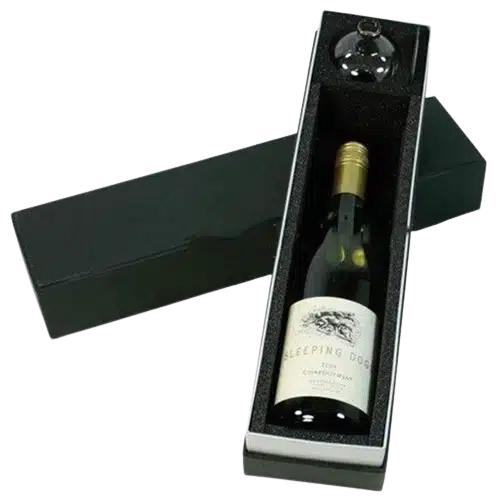
A 750 ml Bordeaux, a Burgundy, and a sparkling wine are three different vessels that all answer to “wine bottle,” and a cavity cut for one does not hold the others. The straight-sided Bordeaux is the easy default; the Burgundy’s sloping shoulders need a cradle that grips lower on the body; the sparkling bottle carries a thick punt and a wider base that a standard cavity floats. A magnum is not a tall 750 — it is a wider, heavier vessel that needs its own cavity and a heavier board, or the base cradle that fits a 750 will let it rock.
The diameter is the number that matters most, but the shoulder profile is the number buyers forget. Name both in the PO, because a cradle sized to a Bordeaux will pinch a Burgundy neck or leave a sparkling base loose enough to pivot. The same thermo-sealed liner and the same board grade apply across shapes; only the cavity and the cradle change. A wine bottle gift boxes line that lists the bottle shape, not just “wine bottle,” returns a cavity that grips the vessel it actually ships, and the clink that shows up in a generic sample run disappears once the shape is named.
Foam, EVA, and Cushion Layering
Protection is layered, not single-material. The first layer is the lock — the cradle or divider that stops motion. The second layer is the cushion — a pad of EVA or PE foam under the base that absorbs the drop energy. The third layer is the slack fill — kraft or moulded pulp around the cavity that takes the side shock. A box that leans on foam alone but leaves the bottle free to pivot will still clink; a box that locks the bottle but has no base pad will crack on a corner drop. Each layer covers a failure the others miss.
Foam density decides the feel and the survival. Closed-cell EVA at 33–45 kg/m³ cushions without compressing flat; open-cell foam is softer but bottoms out faster and recovers poorly after a hard hit. A sparkling or high-value bottle warrants a denser pad and a thicker board; a standard 750 ml in a domestic courier run can use a lighter pad and still pass a one-metre drop. Match the foam to the drop risk, because the pad is the difference between a survived drop and a hairline crack that leaks only after the gift is opened.
Magnets, Ribbons, and the Closure Ritual
The closure is where packaging stops being a shipper and starts being a gift. A neodymium disc magnet set into the lid gives a satisfying snap and keeps the box shut without tape; a ribbon tie or belly band gives the same ritual with zero hardware. Both read premium, but they carry different constraints that a buyer sourcing from a factory needs to name up front rather than discover at the dock.
Magnets and air freight do not always mix. Carriers cap the magnetic field at the package surface, and a strong disc pair can exceed it, forcing a road lane or a field-shielded pack that adds cost and lead time. A ribbon closure has no such limit and ships by any mode, which is why it is the safe default for air-forwarded gift runs. For a wine bottle gift boxes order that flies, name the closure and ask the factory for the surface-field reading, because a magnet that ships fine by sea can be pulled at the air counter and miss the event it was built for. The ritual matters; the lane it ships on matters more.

Shipping Marks, Orientation, and the Cold Chain
The printed mark is a free instruction to every handler between the factory and the door. “This way up” arrows, the glass symbol, and a fragile stamp cost nothing in the dieline and prevent the one flip that cracks a bottle. Add the storage band — wine wants 8–18 °C and away from light — so a warehouse does not stack it under a skylight in July or against a hot dock wall. These marks are the cheapest insurance on the page, and they are the first thing a vague PO drops.
Cold chain is a wine-specific risk that generic packaging briefs miss. A thermo-sealed liner keeps a leak in, but it does not keep heat out; a summer trunk or a warm transit hub can push the wine past its band and spoil the vintage before it is gifted, leak-free but ruined. For warm-lane or long-haul runs, spec an insulated sleeve or a foil-laminated outer, because the liner protects the carton and the insulation protects the wine. The box contains the glass; the lane contains the quality, and the two need separate lines in the brief.
Mini Story: The Six-Pack That Arrived as a Clink
A retailer shipped a six-bottle holiday set in a rigid carton with a corrugated slot divider rated for two bottles, because the two-bottle version was on the shelf and the buyer did not ask. The courier dropped the case on a corner; four of six bottles pivoted through the slack slots, clinked, and two cracked, soaking the insert and the gifts inside. The brand re-spec’d a moulded pulp grid sized to the six 750 ml Bordeaux, kept the same outer carton, and added “this way up” marks. The next run arrived silent — the grid held each neck, and the clink was gone. The failure was a divider chosen by price and availability, not by bottle count, and the fix cost the same carton and a clearer PO.
Mini Story: The Magnet Pulled at the Air Counter
A premium label shipped single-bottle wine box gifts with neodymium disc magnets by air to a trade show, eager for the snap-close unboxing on the booth. At the counter the handler’s meter read over the carrier cap, and the cartons were held while a road lane was arranged, missing the booth setup by two days. The brand switched the closure to a ribbon tie for air runs and kept the magnet version for sea shipments to flagship stores, splitting the SKU by lane. A wine bottle gift boxes decision that names the lane with the closure avoids a counter delay that no foil accent or emboss can recover once the flight is gone.
Wine Bottle Gift Boxes: A Five-Line Spec You Can Send Today
Send five lines and a factory can quote without a call. One: bottle diameter x height in mm. Two: box style—magnetic-lid rigid, drawer, or two-piece. Three: insert type and cavity tolerance (±2 mm). Four: board and wrap (2.0–2.5 mm greyboard, 120 gsm wrap). Five: print and finish. Any wine bottle gift boxes quote that skips these drifts later. Add a ship test: three boxes, one 76 cm corner drop, bottle intact. That single test removes most rework on wine bottle gift boxes.
Specifying Your Wine: Diameter, Shoulder, and Foil Height
Bottles are not one size. Measure three points before specifying your wine: base diameter, shoulder diameter, and total height with foil. A Burgundy runs about 76 mm at the base; a Bordeaux about 75 mm but taller; a magnum closer to 90 mm. Cavity depth should clear the capsule by 3–5 mm, no more. When specifying your wine, also note the punt and label wrap, because a tight cavity scratches the label. Send photos with a ruler; guesses cost a full tooling cycle.
Shipping Compliance for Wine Boxes: Alcohol Marks, Cold, and Drop
Shipping compliance for wine boxes is about documentation and packing as much as the box. Add ABV and volume on the label, include the health-warning text, and keep the country-of-origin mark if exporting. Use a rigid outer carton with 6 mm walls on multi-bottle sets. Prove shipping compliance for wine boxes once: a 76 cm corner drop and a 48-hour soak at 85% RH. Get it right and damage claims fall sharply. Confirm each destination’s duty and label rules before the container leaves—rules differ by market.
Wine Bottle Gift Boxes Wholesale: MOQ, Tooling, and the Unit Math
At volume the numbers shift fast. Rigid magnetic-lid wine bottle gift boxes wholesale usually start at MOQ 500; single-bottle magnetic boxes can open at MOQ 100. Tooling for foil and emboss is one-time and falls as volume rises. At 500 pieces expect roughly 2.5x the 5,000-piece unit price; at 10,000 the die cost is nearly absorbed. Treat wine bottle gift boxes wholesale pricing as two lines: material and labour per piece, plus amortised tooling. Ask the factory to show both.
Wine Bottle Gift Boxes Supplier: Seven Questions Before You Sign
Vet a partner before you commit a gifting season. Ask a wine bottle gift boxes supplier for quarterly output capacity, in-house versus outsourced printing, insert-moulding capability, sample lead time, and past holiday on-time rates. Request a retained counter-sample policy. A steady wine bottle gift boxes supplier will also quote the master carton and pallet plan, not just the unit. Confirm who owns the dieline and that your artwork stays confidential. These answers separate a factory from a trading desk.

-
1. What makes a wine bottle gift box leak-proof?
A thermo-sealed liner welded to the board with no seam is the leak barrier; a glued PE tray has a seam the wine can find. Specify the seal method in the PO, because 'waterproof' without a named weld leaves a path for the first drop. Pair the liner with a moulded cradle so the bottle cannot pivot.
-
2. What insert best locks a wine bottle?
A moulded pulp or EVA cradle with a neck slot and a base cradle locks the bottle by top and bottom so it cannot roll or clink. A corrugated divider works for multi-bottle sets but cushions less. Pick by bottle count and drop risk, because the lock stops the clink.
-
3. How tight should the bottle cavity be?
Cut the cavity to the bottle diameter with about 2 mm slack; a cavity 2 mm larger lets the bottle pivot and clink. Name the bottle diameter in the PO so the cavity is cut to the vessel, not the average. The clink is a cavity problem, not a board problem.
-
4. What print finish suits a premium wine gift box?
CMYK outside with a foil accent reads premium for a fraction of full foil; soft-touch laminate adds a velvet surface; emboss lifts the logo subtly. Name the print sides so the cost lands where the eye does, and the box presents like a flagship instead of a shipper.
-
5. What MOQ makes sense for holiday wine gifting?
Digital short-run starts at 500–1,000 units in 1–2 weeks; offset above 3,000 units lowers the unit price over 3–5 weeks. A moulded insert and thermo-sealed liner add MOQ and tooling. Plan holiday runs in summer so the bulk ships before the Q4 peak and the ex-factory date holds.
-
6. Can a wine box ship without a rigid outer carton?
A single bottle in a telescope or rigid carton with a liner and cradle is the safe default; a mailer with a thick EVA cradle can work for one bottle but cushions less. For multi-bottle or high-value wine, a rigid outer with dividers is the safer pick. Match the outer to the bottle count and the drop risk.
Conclusion
Wine bottle gift boxes is a spec decision, not a price decision. Fix the structure, approve a real sample, and hold the supplier to the numbers on the PO — then the pack does its job before anyone reads the copy. Compare custom printed paper bags, custom paper boxes and packaging by industry to see what fits your product, or email sales@allenboxes.com for a quote on a 100-piece run.

Liverson Li
Hello, I'm Liverson, co-founder of Allenboxes.com. We run a packaging factory in Dongguan. Custom printed paper bags, boxes, pouches, hang tags and cards, made here since 1998. We're not the cheapest and not the biggest. We're the factory that takes a 100-piece order seriously. Email me freely for more details!
Sustainable Packaging Materials in 2026: A Buyer’s Guide to Kraft, Molded Pulp, Bioplastics, Mycelium and Seaweed
Compare 6 sustainable packaging materials for 2026: kraft, molded pulp, PLA, PHA, glassine, mycelium and seaweed. Costs, barriers, PPWR and EPR rules

Read Packaging Supplier Quotation Documents: 5 Numbers That Decide Cost
Meta Title: Read Packaging Supplier Quotation: 5 Hidden Costs 2026 Meta Description: Read packaging supplier quotation lines like a buyer:
Custom Paper Bag Printing Methods: Offset, Flexo, Screen, Hot Stamping
Compare custom paper bag printing methods, offset, flexo, screen, and hot stamping, on cost, MOQ, color, and lead time, plus how to choose the right one.
How to Choose a Reliable Paper Bag Manufacturer in China
Learn to choose a reliable paper bag manufacturer in China: verify certifications, run factory audits, screen red flags, and build the right vetting scorecard.
FSC Certified Paper Bags: What B2B Buyers Need to Know
FSC certified paper bags: FSC 100% vs Mix vs Recycled, how to verify a supplier’s FSC certificate, logo rules, and the lamination vs recyclability trade-off.
Paper Bag Quality Control: What Inspections Happen Before Shipping
Primary Keyword: paper bag quality control Secondary Keywords: paper bag qc inspection · paper bag quality check · bag quality