
A window box lets the product sell itself — the pack does the talking on shelf before the customer touches it. Allen Paper Products builds window gift boxes for food, cosmetic and gift brands across 80+ countries, from MOQ from 100 pcs with digital proofing in days and bulk delivered in 2–3 weeks.
Three scenes where window boxes earn their keep
Food — pastries, confectionery and coffee
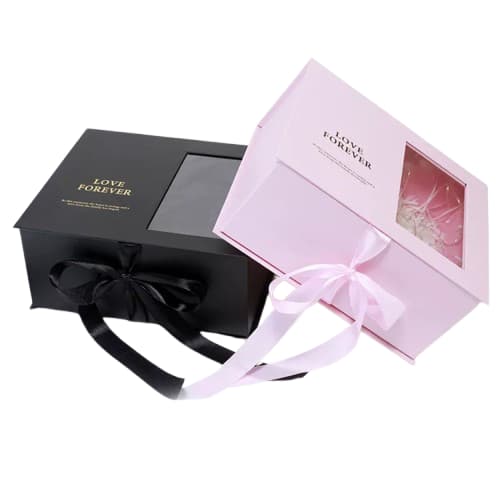
For bakeries, chocolatiers and coffee roasters, the window is the appetite appeal. The standard build is a folding carton with a PET window and a printed sleeve, sized so the product sits centered and fully visible. Food-adjacent applications run soy-ink printing; grease-resistant board options are specified at quote for higher-fat products.
Cosmetics — skincare and gifting sets

For skincare and beauty gifting, the window is usually paired with foil or soft-touch print on the sleeve — the window shows the product, the finish carries the brand. Rigid window boxes are used for premium sets where the box itself is part of the gift.
Gifts — corporate and seasonal

For corporate gifting and seasonal sets, the window shows the assortment without opening the box — useful when the buyer needs to approve contents at a glance. Multi-cup and multi-item trays are cut to the component profile so nothing shifts in transit.
Window craft comparison
| Craft | How it works | Cost position | Best for |
|---|---|---|---|
| PET window patch | Clear film patch applied over a die-cut opening | Lowest tooling | Most food and gift boxes |
| Full die-cut window | Opening cut through board, film mounted behind | Moderate | Larger display areas |
| Tear-open panel | Perforated panel that opens after purchase | Low | Retail with freshness claim |
Sizing and structure notes
- Window placement is drawn on the dieline before tooling — the product should sit centered under the window with 3–5 mm clearance so nothing presses against the film.
- Board weight is chosen by product weight and shelf stacking; we confirm both before quoting.
- Print runs offset from 3,000+ units; digital keeps short runs tooling-free from 100 pcs.
- FSC-ready board and soy-ink printing are standard options; PPWR-ready positioning for EU shipments.
Frequently asked questions
- Does the window protect against dust? Yes — the PET patch seals the opening; for extra protection we add an inner bag or liner at quote.
- Is the film food-safe? We specify food-grade PET for food-adjacent applications — confirm the product at quote.
- Can the window be shaped? Yes — any dieline shape can be die-cut; tooling is confirmed on the proof.
- What is the MOQ? From 100 pcs, with volume tiers at 1,000 / 3,000 / 5,000+.
- How long does production take? Samples in days; bulk 2–3 weeks after sample approval.


Why Your Quote Jumped After the Factory Reviewed Your Artwork
Your quote can jump after artwork review. Learn how bleed, spot colour, foil and die-cuts change price, and how to lock a file-reviewed quote before approval.
Stopping Production After You Spot an Error
Stop production after error found using a confirmation gate. Learn who pays, how to issue a stop order, and how to cap loss before the entire run prints.
Why Your Reorder Looks Different From Your First Batch
A reorder different from first batch traces to paper, ink and machine drift between runs. Sealed golden samples and frozen specs keep repeat orders consistent.
Custom Bubble Mailers: Poly Padded Shipping Guide (2026)
Source custom bubble mailers in bulk: poly padded shipping bags with bubble bonding, self-seal strips, opacity and a buyer QC checklist for shipping.
Why One Box Has Three Different MOQs (Print, Structure, Finish) (2026)
See why one box shows three different MOQs for print, structure and finish. Learn to read process-level minimums and plan your true reorder quantity.

Custom Envelope Liners & Wax Seals: Cutting, Adhesion & Mail Durability
Source custom envelope liners and wax seals: liner cut and adhesion, self-adhesive versus real wax for volume, and how seals survive the mail when mailed.