
Standard Paper Bag Sizes: A Cheat Sheet for Retailers
Ordering a run of standard paper bag sizes sounds simple, until your 300gsm luxury bags arrive and the gift boxes don’t fit, or your grocery bags tear at the handle because the paper was too light for the width. Most sizing mistakes aren’t about taste; they’re about a missing reference point. This cheat sheet gives B2B buyers, brand owners, and promotional-product purchasers a practical, copy-ready table of the most common retail bag sizes, explains exactly how dimensions are measured, and shows how to match a size to a product category. If you’re sourcing custom printed paper bags from a China manufacturer, treat this as your spec sheet before you brief the factory.
Whether you run a boutique in Lisbon or a promotional program in Chicago, the same three numbers decide fit and cost: width, depth (gusset), and height. Get those right, then weigh paper weight and handle drop, and you’ll avoid the two most expensive errors in this category, over-sized bags that waste material and under-sized bags that get rejected by customers. Memorising the three standard paper bag sizes below is the fastest way to brief a factory without ambiguity.
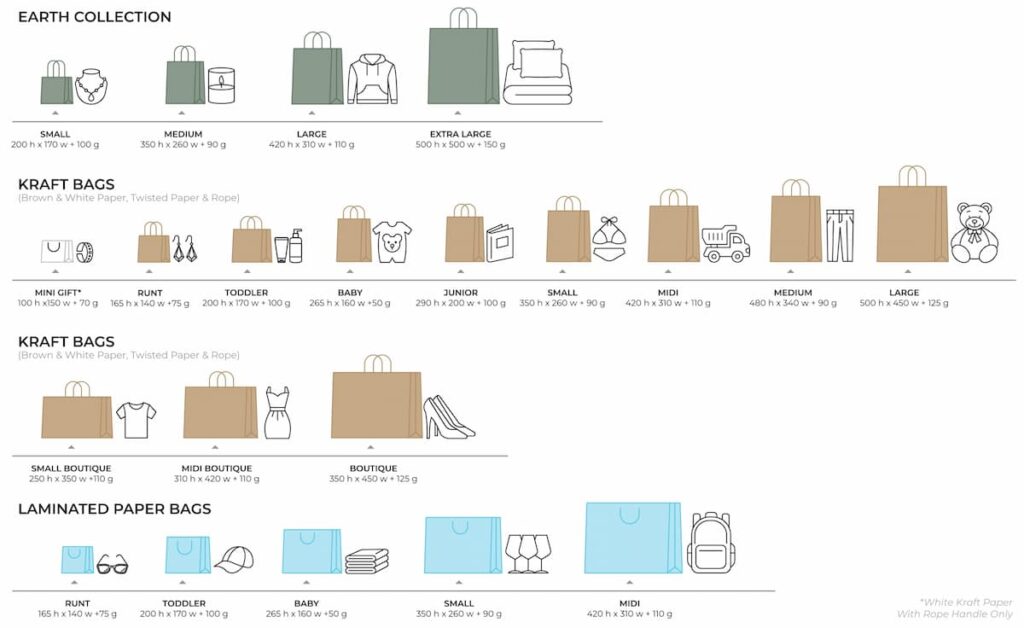
How Paper Bag Dimensions Are Measured
A paper bag is described by three internal dimensions, always in the same order: width × depth (gusset) × height, measured in millimetres (mm) in Asia and Europe, and often in inches in the US market. Width is the front face of the bag from left to right. Depth, also called the gusset, is how far the bag extends front to back when opened. Height is the distance from the base to the top opening.
Handle drop is the fourth number you’ll see on a spec: it’s the vertical distance from the top rim of the bag to the lowest point of the handle loop. A short drop means the bag sits close to the hand; a long drop lets it be carried on the forearm.
| Dimension | What it measures | Typical unit | Common pitfall |
|---|---|---|---|
| Width | Front face, left to right | mm / inch | Confusing width with height on the print panel |
| Depth (gusset) | Front-to-back when open | mm / inch | Forgetting gusset doubles usable capacity |
| Height | Base to top opening | mm / inch | Measuring folded, not standing, bag |
| Handle drop | Rim to handle lowest point | mm / inch | Drop too short for large bags = awkward carry |
Note that the gusset is the single most misunderstood value. A flat 180×90×220mm bag and a 180×90×220mm bag with a 90mm gusset hold very different volumes, but buyers often quote only two numbers. Always confirm all three on your pre-production sample so the factory and your warehouse agree on the same bag.
Small, Medium, and Large Standard Sizes
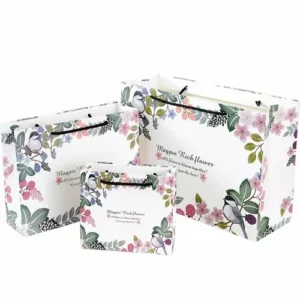
The “standard” three-tier system (small / medium / large) covers the majority of retail and gift use. These standard paper bag sizes are the dimensions most Chinese factories keep as standing tooling, so they are the cheapest to produce and fastest to reorder.
These tiers are not universal, a “medium” in a US grocery chain may be larger than a “large” in a Japanese department store. But for custom printed bags the three rows above are the safest default starting points. If you need help linking paper weight to these sizes, our GSM guide maps each tier to a recommended stock.
“We switched our boutique’s small gift bag from 180×90×220mm to 210×100×260mm and fit rate jumped from 62% to 94%, far fewer returns for ‘too small’.”, Sofia, owner of a Milan stationery shop, May 2025
| Size tier | Width × Depth × Height (mm) | Handle drop (mm) | Typical use | Approx. volume |
|---|---|---|---|---|
| Small | 180 × 90 × 220 | 75–90 | Jewellery, cosmetics, small gifts | ~3.5 L |
| Medium | 240 × 110 × 300 | 100–120 | Apparel, books, mid gift boxes | ~8 L |
| Large | 320 × 130 × 410 | 120–150 | Shoes, bundles, grocery top-ups | ~17 L |
Size by Product Category: The Quick Cheat Table
Different products need different proportions, so the fastest way to narrow standard paper bag sizes is by product category. A wide, shallow bag suits flat items; a tall, narrow bag suits bottles and rolled goods. Use this table as a first-pass selector, then refine with the gusset. When you brief a supplier, send the category and the exact product you must fit, not just a tier name. The top 10 questions to ask your supplier include a sizing checklist that prevents the “it looked right in the photo” problem.
| Product category | Recommended size (W×D×H mm) | Handle | Notes |
|---|---|---|---|
| Cosmetics / jewellery | 160×80×200 | Short rope or die-cut | Keep gusset small, print panel is narrow |
| Apparel (1 tee/shirt) | 240×110×300 | Twisted paper | Medium tier is the safe default |
| Shoes (1 pair) | 320×130×410 | Flat ribbon | Large tier; check box height first |
| Gift (mixed) | 210×100×260 | Satin or rope | Slightly taller than small tier |
| Wine / bottle (1) | 120×90×350 | Die-cut or rope | Tall and narrow — see section below |
| Grocery / carry | 280×150×350 | Reinforced twisted | Wider gusset for bulk |
Wine Bottle and Bottle Bag Sizes
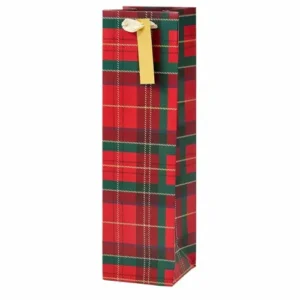
Bottle bags are a special case: the product is tall, heavy, and round, so the bag must be narrow with enough height to cover the neck. A single-bottle wine bag is typically 120×90×350mm, which cradles a standard 750ml bottle (around 300mm tall) with headroom for the neck and a folded top. Because a full wine bottle weighs ~1.2kg, the paper here should not be the light 90–120gsm used for gift bags, step up to 150–210gsm or add a base board. If sustainability is part of the brief, pair these dimensions with FSC-certified paper so the premium feel doesn’t cost you a certification gap (see the FSC standard for chain-of-custody basics).
| Bottle type | Bag size (W×D×H mm) | Capacity | Handle |
|---|---|---|---|
| Single wine (750ml) | 120 × 90 × 350 | 1 bottle | Die-cut or short rope |
| Double wine | 180 × 90 × 350 | 2 bottles | Reinforced rope |
| Champagne / taller | 130 × 100 × 380 | 1 bottle | Rope, wider gusset |
| Spirit (1L) | 140 × 100 × 360 | 1 bottle | Rope, heavier stock |
Grocery and Carry Sizes
Grocery and promotional carry bags trade elegance for volume and strength. A common carry size is 280×150×350mm, but for heavier loads you’ll want a wider gusset and a reinforced handle patch. The US “standard” grocery sack is far larger, often 330×180×410mm or bigger, while European boutique grocery tends toward the medium tier.
The bigger the bag, the more it matters that the paper weight matches the load. A 17L large bag at 120gsm will sag and split at the handle; the same bag at 200gsm carries comfortably. This trade-off is the reason sizing and GSM must be specified together, never separately.
Size vs GSM: Heavier Paper for Bigger Bags
| Bag size tier | Min. GSM (kraft) | Min. GSM (coated/laminated) | Why |
|---|---|---|---|
| Small (≤220mm H) | 100–120 | 120–150 | Low load, short handle drop |
| Medium (≤300mm H) | 120–150 | 150–190 | Moderate load, longer drop |
| Large (≥350mm H) | 150–210 | 190–250 | High load, handle stress peaks |
| Wine / bottle | 150–210 | 190–230 | Concentrated 1.2kg point load |
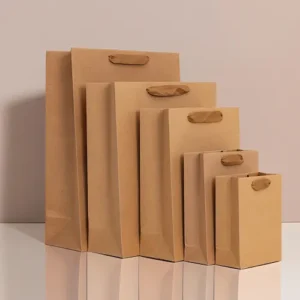
GSM (grams per square metre) is the paper’s basis weight. As the bag gets bigger, the lever force on the handle and seams grows faster than the paper area, so you need a higher GSM to keep the same margin of safety. Pairing standard paper bag sizes with the right GSM is the single biggest durability lever, and the table below is a starting reference for twisted-handle kraft and coated art paper bags.
Match the size to the right paper weight in our GSM guide before you lock the quote, changing GSM after tooling is set usually means a new print plate. The finish you choose also interacts with size: a matte vs gloss lamination decision changes how a large printable panel reads, and gloss can emphasise seams on very tall bags.
Handle Length Rules by Bag Size
Handle drop should scale with bag height so the bag hangs naturally and the weight balances on the hand or forearm. As a rule of thumb:
- Small bags: 75–90mm drop
- Medium bags: 100–120mm drop
- Large bags: 120–150mm drop
- Wine / bottle: 90–110mm drop (shorter, to keep the bottle upright)
Longer drops on large bags let customers carry on the forearm, which reduces handle-pull stress. For the full range of options, rope, twisted, ribbon, die-cut, and how each pairs with a size, see our handle types guide. The same guide covers why a die-cut handle on a large bag is a false economy: there’s no reinforcement patch, so the rim tears under load.
EU vs US / Asia Size Conventions
When standard paper bag sizes cross borders, the biggest confusion is the unit and the order. Asia and Europe quote mm in the order W × D × H. US suppliers often quote inches, and some list height first. A “10×5×13” in the US is roughly 254×127×330mm, close to our medium tier, but not identical, and the gusset may be implied rather than stated. Confirm the mm-vs-inch convention with your factory in writing, this is exactly the kind of item our manufacturer certification checklist is built to confirm, and it prevents a 10% size drift that ruins shelf fit. For buyers comparing overseas partners, our guide to a reliable China manufacturer includes a spec-confirmation template. Regional measurement conventions are also summarised in public references such as ISO packaging standards.
| Region | Unit | Typical order | Gusset stated? |
|---|---|---|---|
| China / Asia | mm | W × D × H | Yes, usually |
| EU | mm | W × D × H | Yes |
| US | inch | Often H first | Sometimes implied |
Common Sizing Mistakes (and the Fix)
- Quoting only two dimensions. Fix: always send W × D × H plus handle drop.
- Using a photo instead of a spec. Fix: send a measured drawing; the PPS step exists to confirm this.
- Light GSM on a large bag. Fix: follow the size↔GSM table above.
- Handle drop too short for the height. Fix: scale drop with size (see handle section).
- Assuming “medium” is universal. Fix: state exact mm, not the tier word.
- Ignoring print panel change from gusset. Fix: a wider gusset shrinks the flat front panel, review printing methods for panel limits.
- No QC on arrival size. Fix: build a tolerance check into your quality control plan.
“Our US team sent ‘13×7×10’ expecting our Asian medium, but it arrived in inches and the boxes didn’t fit the shelf, we lost two weeks of promo. Now every PO states mm and spells out W×D×H.”, Daniel, procurement lead at a Toronto cosmetics brand, March 2026
When to Request a Pre-Production Sample (PPS) to Confirm Size
A PPS is a small, charged prototype run used to confirm size, print, and construction before the full order. Request one whenever:
- You’re changing size tier or gusset for an existing product
- You’re launching in a new region with different unit conventions
- The bag must fit a specific branded box (measure the box, then the bag)
- You’re combining a new handle type with a new size
A PPS guide walks through exactly what to check, and a quality control article explains how to turn that sample into an incoming-inspection standard aligned with ISO 9001 quality management. If lead time is tight, note that a sample round adds days, budget for it rather than skipping it.
“We shipped 8,000 large bags at 130gsm because the factory reused an old spec; handles pulled through on 1 in 9. A PPS at the right GSM would have caught it for under $80.”, Aiko, operations manager at an Osaka promotional agency, November 2025
Decision / Sizing Matrix
Use this matrix as a final check before you send the purchase order. It locks standard paper bag sizes together with GSM and handle drop in one line, so find your product, confirm the size, then confirm the GSM and handle drop alongside it. For the environmental side of the spec, pair any of these with FSC-certified stock, and keep your certifications verified so the claim holds up to audit.
| If your product is… | Start with size (W×D×H mm) | GSM (min) | Handle drop | Also confirm |
|---|---|---|---|---|
| Small gift / cosmetics | 180×90×220 | 120 | 75–90 | Gusset not over 90 |
| Apparel / book | 240×110×300 | 150 | 100–120 | Print panel width |
| Shoes / bundle | 320×130×410 | 200 | 120–150 | Base reinforcement |
| Wine / bottle | 120×90×350 | 190 | 90–110 | Neck headroom |
| Grocery / carry | 280×150×350 | 200 | 120–140 | Gusset & handle patch |

-
1. What are the most common standard paper bag sizes?
The three retail tiers most factories tool for are Small 180×90×220mm, Medium 240×110×300mm, and Large 320×130×410mm (width × depth × height). Wine bags run narrower and taller at about 120×90×350mm. These cover most gift, apparel, and carry use; state exact millimetres rather than the tier word to avoid regional drift.
-
2. How are paper bag dimensions measured?
Dimensions follow the order width × depth (gusset) × height, measured internally in mm in Asia and Europe and often in inches in the US. Width is the front face, depth is the front-to-back gusset when open, and height is base to top. Handle drop, the rim-to-handle distance, is quoted separately and should scale with bag height.
-
3. What size paper bag fits a wine bottle?
A standard 750ml wine bottle needs a bag around 120×90×350mm: narrow enough to cradle the bottle, tall enough to cover the neck with folding headroom. Double-bottle bags are about 180×90×350mm. Use 150–210gsm or a base board because a full bottle weighs roughly 1.2kg and concentrates load at one point.
-
4. Does a bigger paper bag need heavier paper?
Yes. Handle and seam stress grow faster than paper area as the bag enlarges, so GSM must rise with size. As a baseline: small bags 100–150gsm, medium 150–190gsm, large 190–250gsm, and wine/bottle 150–210gsm. Specifying size and GSM together prevents sagging and handle pull-through.
-
5. What handle length should I use for each bag size?
Scale handle drop with height: small 75–90mm, medium 100–120mm, large 120–150mm, and wine/bottle 90–110mm. Longer drops on large bags allow forearm carry and reduce handle-pull stress. Avoid die-cut handles on large bags, which lack a reinforcement patch.
-
6. Are US and EU paper bag sizes the same?
Not exactly. Asia and the EU quote millimetres in W × D × H order with the gusset stated; US suppliers often quote inches, sometimes height-first, and may imply the gusset. Always confirm units and order in writing to prevent a ~10% size drift that ruins shelf or product fit.
-
7. When should I order a pre-production sample to confirm size?
Request a PPS whenever you change size tier or gusset, enter a new region with different units, must fit a specific branded box, or combine a new handle with a new size. A sample costs little and catches sizing, GSM, and print-panel errors before a full run, typically adding only a few days to lead time.
Conclusion
Standard paper bag sizes are only “standard” once you define them in millimetres with width, depth, and height stated explicitly, plus handle drop and GSM. Use the tier tables and the category cheat sheet above as your spec baseline, confirm units with the factory, and never separate size from paper weight. For the full sourcing picture, start from our pillar guide to custom printed paper bags, then drill into GSM, handles, finishes, and manufacturer selection. Get the dimensions right on a PPS and the rest of the order falls into place.

ALLEN LEE
Hi, I’m Allen Lee, the owner of Allenboxes.com, I’ve been in the packaging industry for over 20 years and running a factory in China that produce for 10+ years, and the purpose of this article is to share with you the knowledge related to packaging from a Chinese supplier’s perspective.
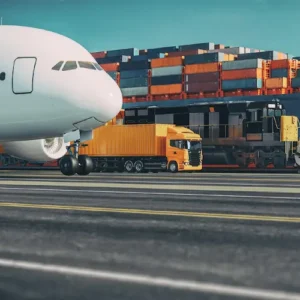

3 Steps to Save Shipping costs
Step 1: Use foldable boxes instead of two-piece rigid boxes.
Step 2: Customize to a smaller box. And Order early to use economy ocean freight instead of air.
Step 3: Select Door to door service include all taxes and freight.
Why Your Quote Jumped After the Factory Reviewed Your Artwork
Your quote can jump after artwork review. Learn how bleed, spot colour, foil and die-cuts change price, and how to lock a file-reviewed quote before approval.
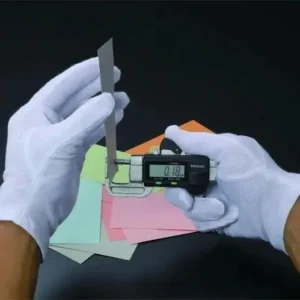
5 tips about Materials of Paper Boxes
1.Measure thickness of raw material
2.Cut a 10x10cm sheet
3.Measure paper weight
4.Measure paper thickness
5.Check standard weight-thickness tables
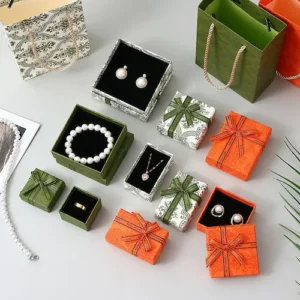
12 Common Box Inserts Introduction
1.Sponge (with velvet or paper)2.EVA Foam 3.Pearl cotton (EPE)
4.Paper Cardboard 5.Corrugated Paper 6.Plastic Blister
7.Tissue Paper 8.Raffia Filler9.Bubble Beads
10.Satin Fabric,11.Small Pouches 12.Mini Pillows
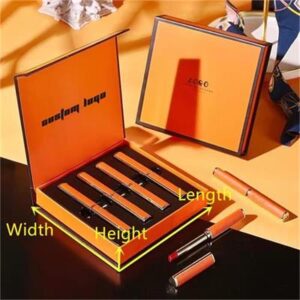
6 steps to customize paper boxes
1. Design Box style, Colors, Logos.
2. Meet the budget.
3. Revisions & Prototyping
4. Final Approval & Refinement
5. Small-Batch Testing
6. Mass Production
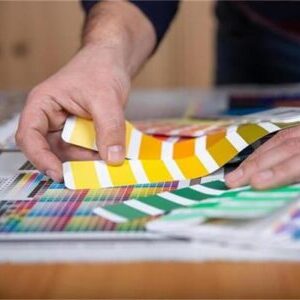
How to control color discrepancy of paper boxes
1.Same materials /ink batch
2.Same printing machines & crew
3.Same finishing (lamination/coating)
4.Identical inspection tools + standards
5. Smart color choices (e.g., black + embossed logo)